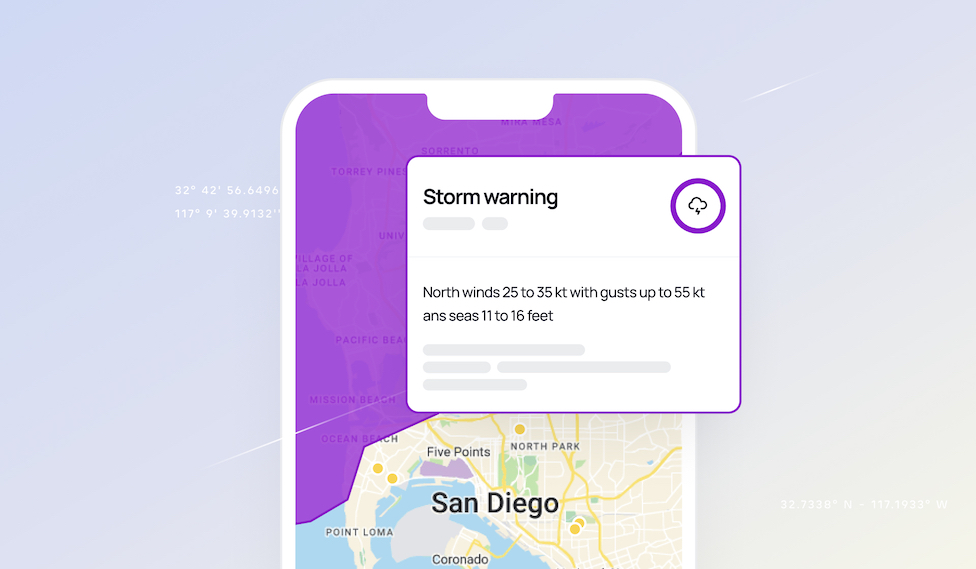
Heat stress monitoring for outdoor workers: from manual spot-checks to automated alerts
It was 94°F by 10 a.m. on a Texas job site, and the heat index was still climbing. The site supervisor checked his weather app, saw conditions that looked manageable, and told the crew to keep working. By 1 p.m., two workers were showing signs of heat exhaustion. One lost consciousness and was transported to the hospital, an outcome that a more accurate picture of conditions on that specific site might have prevented entirely.
Modern safety systems go well beyond consumer weather apps, manual spot-checks, and county-level alerts. They provide real-time, location-specific data, automated alerts, and pre-programmed response workflows that protect workers without depending on human judgment at the worst possible moment.
Why manual heat monitoring fails at scale
Most employers who take heat safety seriously still rely on processes that have fundamental gaps, not because they're careless, but because the limitations of manual monitoring aren't always obvious until something goes wrong (and, of course, for institutional reasons such as difficulties updating enterprise systems, keeping on top of technology, etc.)
- The first problem is frequency. Spot-checks are, by definition, infrequent. The heat index can climb by 15°F in under an hour, which means a reading taken at 9 a.m. can be dangerously outdated by mid-morning. No supervisor working hard and checking conditions every hour or two can keep pace with how quickly outdoor conditions change.
- The second problem is precision. Weather apps pull regional data, often from airport stations or NWS monitoring points miles away. Job Site A and Job Site B, five miles apart, can have meaningfully different temperature and humidity readings depending on surface materials, shade coverage, proximity to water, and airflow. A weather app gives you a regional approximation; it doesn't tell you what's happening where your workers actually are.
- The third problem is human decision-making under production pressure. Manual monitoring requires someone to make the call: stop work, extend rest breaks, send workers home early. That decision carries real financial and scheduling consequences, and research consistently shows that people under pressure to maintain productivity delay protective action. Automated systems remove the human decision point from the equation.
- The fourth problem is perhaps the most underappreciated: workers cannot reliably self-report early heat stress. Cognitive impairment begins before people notice their own symptoms. By the time a worker tells a supervisor they feel unwell, they may already be in a dangerous physiological state. This is where automation comes in.

What modern heat stress monitoring technology actually does
Hyperlocal environmental monitoring
Modern heat monitoring platforms don't rely on regional weather services. They combine hyperlocal data models with on-site IoT sensors to deliver address-level conditions for each job site. That distinction matters enormously in practice. The same afternoon that reads as "hot but manageable" on a weather app might be genuinely dangerous at a blacktop paving site two miles from the nearest reporting station.
WBGT vs. heat index: why it matters
The standard heat index accounts for temperature and humidity. WBGT goes further, incorporating four factors simultaneously: air temperature, humidity, radiant heat from the sun, and air movement. For workers in direct sunlight performing heavy physical labor, the difference between the two readings can be significant, and OSHA's proposed standard specifically recommends WBGT for outdoor work environments.
Modern platforms integrate WBGT data directly into automated decision thresholds, so responses are calibrated to actual physiological risk rather than a simplified approximation.
Automated workflow triggers and alerting
"Automated" is a word that gets applied loosely in safety technology. In practice, here's what it looks like for heat monitoring:
- Heat index hits 90°F at Job Site 3 → a rest break reminder fires immediately to all workers via SMS, Slack, large indoor or outdoor display, and the PA system, and the event is logged automatically to the OSHA compliance record.
- WBGT forecast shows dangerous conditions the following afternoon → the supervisor receives an alert the night before, with enough lead time to adjust scheduling or positioning before workers arrive.
- A worker check-in is overdue during high-heat conditions → an automatic two-way wellness check is initiated without waiting for someone to notice the gap.
Each of these replaces a decision that would otherwise require a human to recognize a problem, decide to act, and follow through.
Biometric monitoring for high-risk environments

Heat stress affects everyone differently. The only truly sure way to understand heat's effect on an individual is to monitor their biometrics. For lone workers or high-risk environments in particular, wearable biometric armbands add another layer of safety.
These devices track physiological indicators like heart rate, skin temperature, and sweat rate. They can also detect individual heat stress responses before symptoms become visible, or in situations where an individual is falling prey to heat illness due to individual rather than external circumstances.. For workers operating alone in remote or confined settings, they can be the difference between a near-miss and a fatality. Kepler51 uses SlateSafety devices, known for their advanced features like slip and fall detection,and no-movement alerts.
Reaching workers who don't have phones

One of the most common gaps in heat safety programs goes unaddressed because it's uncomfortable to acknowledge: many of the workers at highest risk from heat illness don't have smartphones accessible during the workday. Field workers, construction crews, and agricultural workers often can't or don't carry personal devices on the job.
Modern platforms account for this by reaching workers through PA systems, digital signage, and outdoor siren-based alerting. An alert that only reaches supervisors' phones, or only desk workers, isn't a complete heat warning system. A complete system delivers the message to every person on the site, regardless of what's in their pocket.
The OSHA heat landscape: what compliance requires right now
Heat stress monitoring is a regulatory reality today, even if not exactly in the form most people expected a year ago.
OSHA published its proposed Heat Injury and Illness Prevention Standard in August 2024. The public comment period closed in January 2025, an informal public hearing ran through June and July 2025, and the extended post-hearing comment period closed October 30, 2025 (OSHA Heat Rulemaking page). Since then, the rule has stalled.
That does not mean the pressure is off. On April 10, 2026 – just two days after the original Heat National Emphasis Program (NEP) expired – OSHA announced a revised NEP that took effect immediately and will remain in place for up to five years. The updated program directs inspection priorities to 55 high-risk indoor and outdoor industries, prioritizes in-person response to heat-related complaints and hospitalizations, and authorizes random inspections in those industries any time the National Weather Service issues a heat advisory or warning (HIPAA Journal).
OSHA heat-related fines exceeded $2 million industry-wide in 2024 alone under its Heat National Emphasis Program.
The proposed rule's framework is still the operating blueprint for serious employers, both because it reflects current science and because it remains the most likely shape of any future federal standard. It sets two key thresholds: at 80°F, active monitoring begins; at 90°F, mandatory paid rest breaks kick in and WBGT (Wet Bulb Globe Temperature) monitoring is recommended. It calls for a written Heat Illness and Injury Prevention Plan (HIIPP), acclimatization protocols, drinking water, and training for workers and supervisors (Federal Register NPRM, Aug. 30, 2024).
Why it is hard to stay compliant
The operational challenge is compliance at scale. Manually tracking conditions, logging data, scheduling and documenting rest breaks, and maintaining records across ten or more worksites is an enormous administrative burden — and under the renewed NEP, those records are exactly what inspectors will ask for when they arrive. For multi-site operations, manual compliance processes are fragmented at best and unreliable at worst.
Automated heat stress monitoring systems address this directly, not just as safety tools, but as compliance infrastructure that creates an auditable record of conditions and responses across every site, every day.
Whether the federal rule finalizes next year or five years from now, the enforcement environment, state-level obligations, and General Duty Clause exposure already make that infrastructure worth having.
From reactive to predictive: the shift that saves lives
Traditional heat safety programs are reactive. Conditions become dangerous, someone notices, and a response is initiated. The problem is that the window between "dangerous" and "critical" can be shorter than the time it takes to act.
Predictive monitoring changes the operational timeline. By combining historical weather patterns, real-time environmental feeds, and machine learning, modern platforms forecast heat risk 24 to 48 hours ahead. That advance notice has concrete operational value:
- Shift schedules can be restructured the evening before, moving heavy work to cooler morning hours.
- Hydration stations can be positioned and stocked before workers arrive.
- Staffing decisions — including whether to bring in relief crews or reduce headcount — can be made with enough lead time to actually execute them.
The financial case for this investment is straightforward. Heat-induced lost labor productivity costs the U.S. economy approximately $100 billion annually — a figure cited by OSHA, the Economic Policy Institute, and Public Citizen. And in OSHA's own regulatory impact analysis of the proposed heat standard, the agency calculated that employer savings from compliance are projected to outweigh implementation costs by $1.4 billion per year.
Building a heat stress monitoring program — a practical checklist
1. Audit your current monitoring process. Document what you're actually doing today — how often conditions are checked, who is responsible, and how the information reaches workers and supervisors. Most operations discover gaps they weren't aware of.
2. Identify your high-risk worker populations. Not all workers face the same exposure. Workers acclimatizing to heat, those performing heavy physical labor, those in direct sun, and those without reliable access to fluids or shade are at elevated risk and should be the focus of your monitoring design.
3. Map your communication reach. Ask one specific question: can you reach every worker on every site within 60 seconds? If the answer is no or you're not sure, that's the gap your program needs to close first.
4. Evaluate WBGT vs. heat index for your operations. If your workers are in direct sunlight performing moderate to heavy physical work, WBGT monitoring is the more appropriate standard. If you're relying on heat index alone, you may be underestimating actual physiological risk.
5. Define threshold-to-action protocols in writing before the season starts. Every threshold should have a pre-assigned response: who is notified, what action is taken, and how it's logged. Decisions made under heat stress — by supervisors who are also hot and under pressure — are not the decisions you want to rely on.
6. Test your system in April. Run a full test before conditions are actually dangerous. Verify that alerts fire correctly, that every communication channel reaches the intended workers, and that compliance logging captures what it needs to. Finding a gap in April costs nothing. Finding it in July costs much more.
Frequently asked questions
What is heat stress monitoring for outdoor workers? Heat stress monitoring is the ongoing process of measuring environmental conditions, such as temperature, humidity, radiant heat, and wind speed, at outdoor worksites and for lone workers. The goal is to identify dangerous heat exposure before it causes illness, injury or death. Modern programs use a combination of IoT sensors, hyperlocal weather data, and automated alerting to track conditions continuously and trigger protective actions without depending on manual checks.
How is WBGT different from heat index? The heat index reflects temperature and humidity only. Wet Bulb Globe Temperature (WBGT) adds two more variables: radiant heat from solar exposure and air movement. For workers doing physical labor in direct sunlight, WBGT more accurately represents the physiological stress their bodies are under. OSHA's proposed heat standard recommends WBGT specifically for outdoor work environments, and modern monitoring platforms integrate it into automated response thresholds.
Can automated heat monitoring systems reach workers without smartphones? Yes! And, this is a critical design requirement for any program that covers field crews, construction workers, or agricultural workers. Modern platforms deliver alerts through PA systems, digital signage, and outdoor sirens, ensuring that warnings reach every worker on site regardless of personal device access.
What does OSHA currently require for heat monitoring?
There is no final federal heat standard yet. The proposed rule (NPRM published August 30, 2024) has stalled after the post-hearing comment period closed October 30, 2025, and no finalization date has been set. However, OSHA's renewed Heat National Emphasis Program (effective April 10, 2026, for up to five years) authorizes targeted and random inspections in 55 high-risk industries whenever the National Weather Service issues a heat advisory or warning, and OSHA can still cite employers for heat hazards under the General Duty Clause. Several states — including California, Colorado, Maryland, Minnesota, Nevada, Oregon, and Washington — enforce their own heat illness prevention standards. The proposed rule's framework (monitoring at 80°F, mandatory paid rest breaks and WBGT monitoring at 90°F, a written HIIPP, acclimatization, water, and training) remains the best blueprint for a defensible program, and most modern monitoring platforms are built around it.
What is the ROI of heat stress monitoring technology?
Heat-induced lost labor productivity costs the U.S. economy approximately $100 billion annually. OSHA's own regulatory impact analysis of the proposed heat standard found that employer savings from compliance outweigh implementation costs by $1.4 billion per year. OSHA heat-related fines exceeded $2 million industry-wide in 2024 alone. Automated monitoring systems also reduce the administrative burden of OSHA compliance documentation — a cost that will grow significantly as the new heat standard takes effect.