
Hurricane preparedness for businesses: how technology transforms response and resilience
The scale of hurricane damage continues to grow. According to NOAA, the average annual cost of hurricane damage in the United States has exceeded $20 billion in recent years.
One year after Hurricane Helene, 30 percent of impacted businesses reported breaking even, while 30 percent remained below breakeven or operating at a loss. impact of hurricanes extends to permanent business closures, too.
The good news? Technology has fundamentally changed what's possible in hurricane preparedness. Where manual monitoring once left businesses blind and vulnerable, modern critical event management platforms enable organizations to anticipate hurricane impacts days in advance, coordinate response with precision, protect critical assets through automated protocols, and recover faster through comprehensive documentation.
How manual monitoring fails during hurricanes
To understand what technology enables, it's worth examining what manual monitoring cannot do:
Fragmented data sources create dangerous blind spots. Most businesses monitor hurricane threats using a combination of weather apps, local news, and the National Weather Service. Each source provides somewhat different information: different forecast models, different confidence levels, different geographic coverage areas.
A business or safety leader trying to synthesize information from different sources faces an impossible task: conflicting data, unclear risk assessment, and pressure to make high-stakes decisions with incomplete information.
Broad weather alerts over-alert and under-alert simultaneously. The National Weather Service issues hurricane watches and warnings for broad geographic areas. A hurricane warning polygon might cover several counties, affecting hundreds of thousands of people and businesses. For any individual facility, this creates a dilemma: either close based on a warning that might miss your location entirely, or stay open and hope you're not in the storm's path. The result? Businesses either suffer unnecessary closures costing thousands in lost productivity, or are caught unprepared when conditions deteriorate faster than expected.
Manual decision-making introduces dangerous delays. When a hurricane is 48-72 hours away, a business leader might decide to close facilities, but the process of communicating that decision takes time.
- Send an email, and some employees won't see it.
- Call employees, and you can't reach everyone.
- Text employees
- Use an all-hands meeting, and people aren't present.
By the time all employees know about the closure, you've lost valuable preparation time. And if the hurricane track shifts and your facility turns out to be in more danger than initially thought, those delays become critical.
Lack of coordination across multiple locations creates inconsistency. A company with facilities in multiple regions faces a complex question: which facilities should close and which can continue operating? Without integrated weather data specific to each location, decisions become inconsistent. One facility manager closes conservatively, another keeps operations running, and if the hurricane shifts course, one location pays a hefty price for the difference in approach.
No real-time operational context makes decisions incomplete. A weather forecast tells you wind speed and rainfall. It doesn't tell you where your employees are located, which buildings are actually at risk, what equipment needs to be protected, or which business functions can't tolerate disruption. A business leader making closure decisions without this operational context is flying blind.
How modern technology transforms hurricane preparedness
Modern critical event management platforms solve these problems by integrating weather intelligence with operational data, automated response protocols, and by enabling coordination that would be impossible with manual processes.
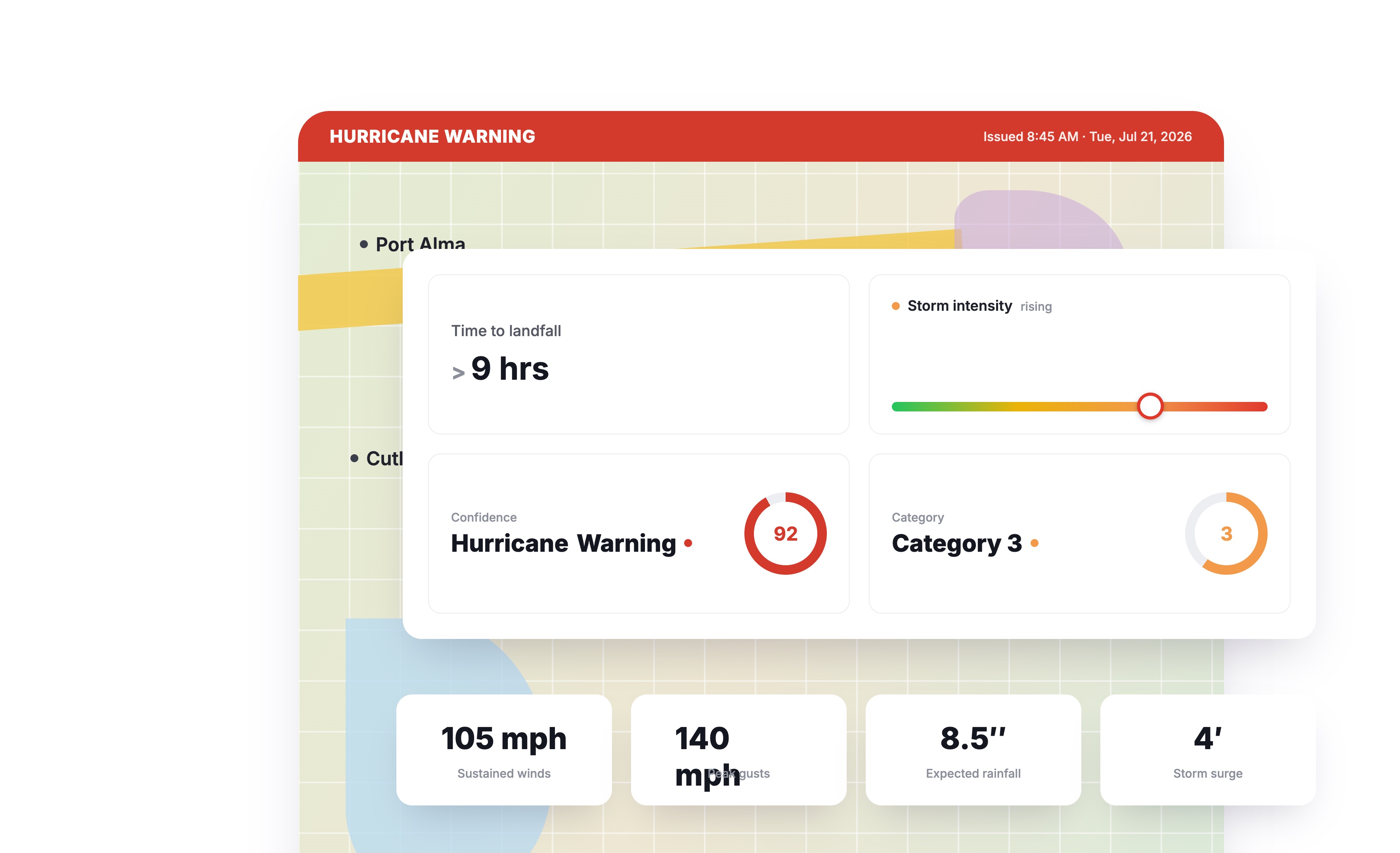
Predictive analytics and hyper-local forecasting: Instead of relying on broad regional forecasts, modern platforms combine official weather service data with proprietary models to generate location-specific hurricane forecasts. Rather than knowing "a hurricane is forecast to impact the region," you know exactly which of your facilities are in the forecast cone, with what wind speeds, what storm surge heights, and what confidence levels. This precision comes days in advance, allowing you to plan protective measures methodically rather than scrambling as conditions deteriorate.
Organizations using these systems not only forecast hurricane impacts 48-72 hours ahead, but are enabled to move critical inventory, arrange alternate work locations, communicate closures with plenty of notice, and execute protective measures before conditions become dangerous.
Integrated data orchestration merges weather and operations: The most powerful systems connect weather data with your operational data. The platform knows not just that a hurricane is forecast, but exactly which of your facilities are in the forecast path, which employees work at each facility, where critical equipment is located, what your supply chain dependencies are, and what business continuity arrangements you have in place.
This integrated view transforms decision-making from guesswork to data-driven analysis. When a hurricane forecast updates, the system immediately shows you the implications for your specific operations:
This forecast change puts Facility 3 in the eye of the storm — activate relocation protocol. Facilities 1 and 2 are in the outer bands — implement standard preparedness. Facility 4 is outside the forecast cone — no action required.
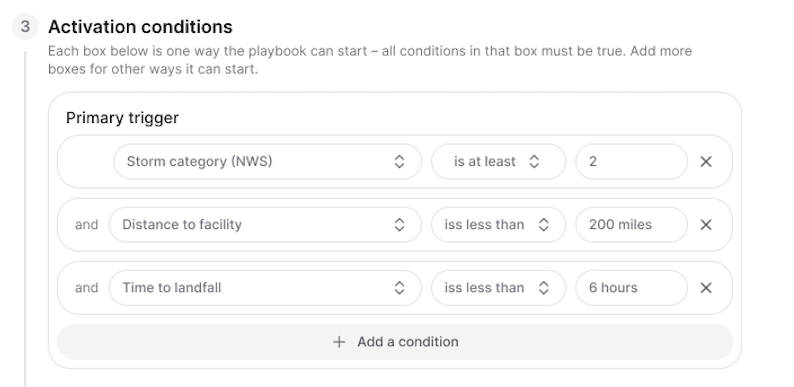
Automated protocols remove human delay: Once you've decided to close a facility or implement protective measures, manual communication is painfully slow. A modern platform executes protocols automatically: instantly alerts all affected employees across multiple channels (text, email, app notifications, voice calls), triggers equipment shutdown sequences to protect sensitive machinery, notifies vendors of potential supply chain disruptions, and documents everything for compliance and analysis.
Where manual notification might take 30 minutes to reach all employees, automated systems achieve the same in seconds. In hurricane scenarios where conditions can deteriorate rapidly, those minutes matter enormously.
Multi-channel communication ensures universal reach: Hurricanes often damage infrastructure—power lines go down, internet becomes unreliable, cell networks become congested. Platforms that deliver messages through multiple channels simultaneously ensure message delivery even when some channels fail. An employee might miss a text message, but they'll see the PA announcement, the digital display, or the app notification. This redundancy means critical safety information reaches everyone.
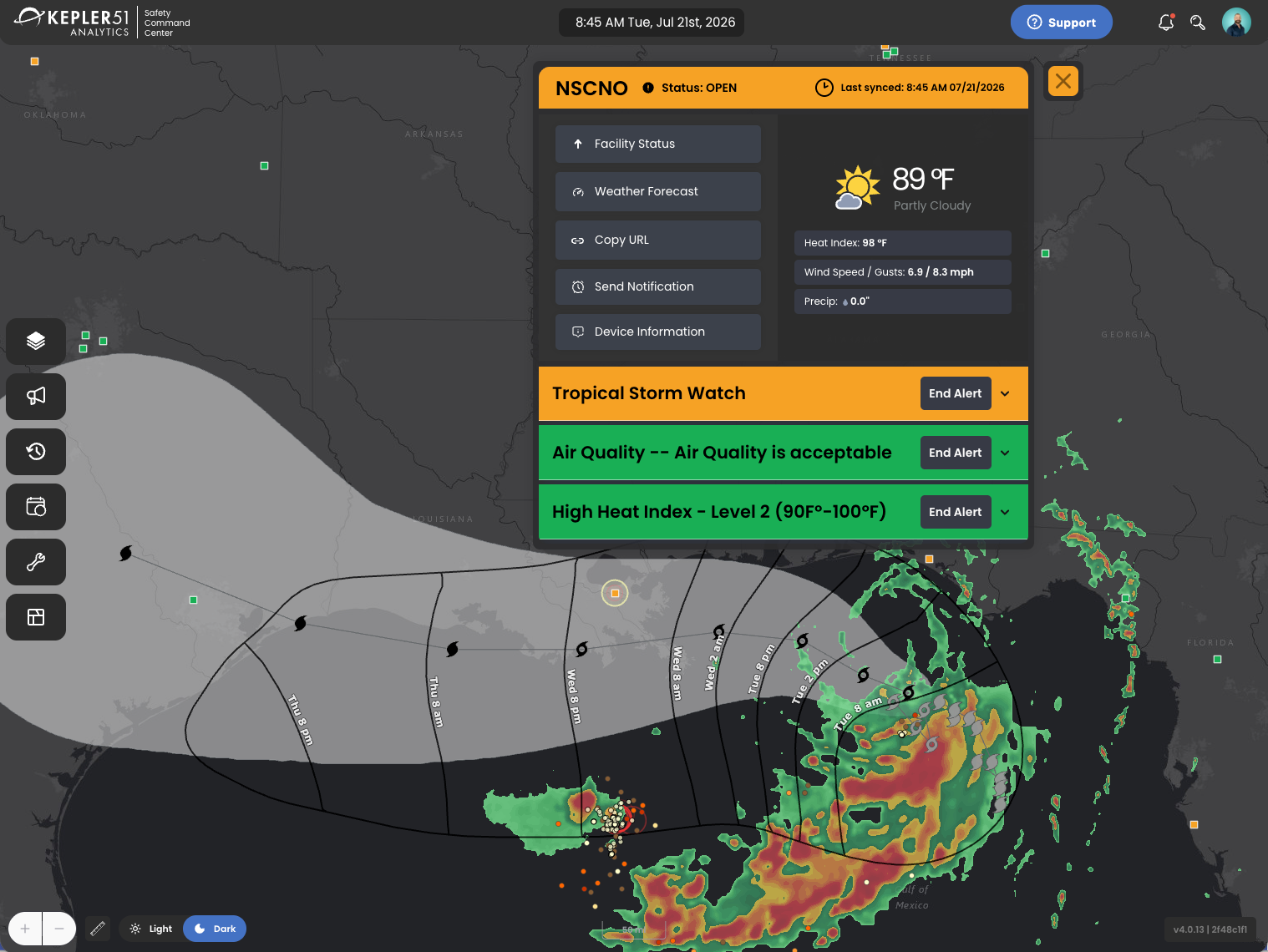
Real-time situation awareness enables coordinated response: Interactive digital maps show decision-makers exactly what's happening: current hurricane position and forecast cone, which facilities are in impact zones, where employees are sheltering, which business functions have been shut down, what protective measures are in progress. This shared situational awareness enables coordinated response: managers at headquarters can see which site needs additional resources, which has completed evacuations, and which is still vulnerable.
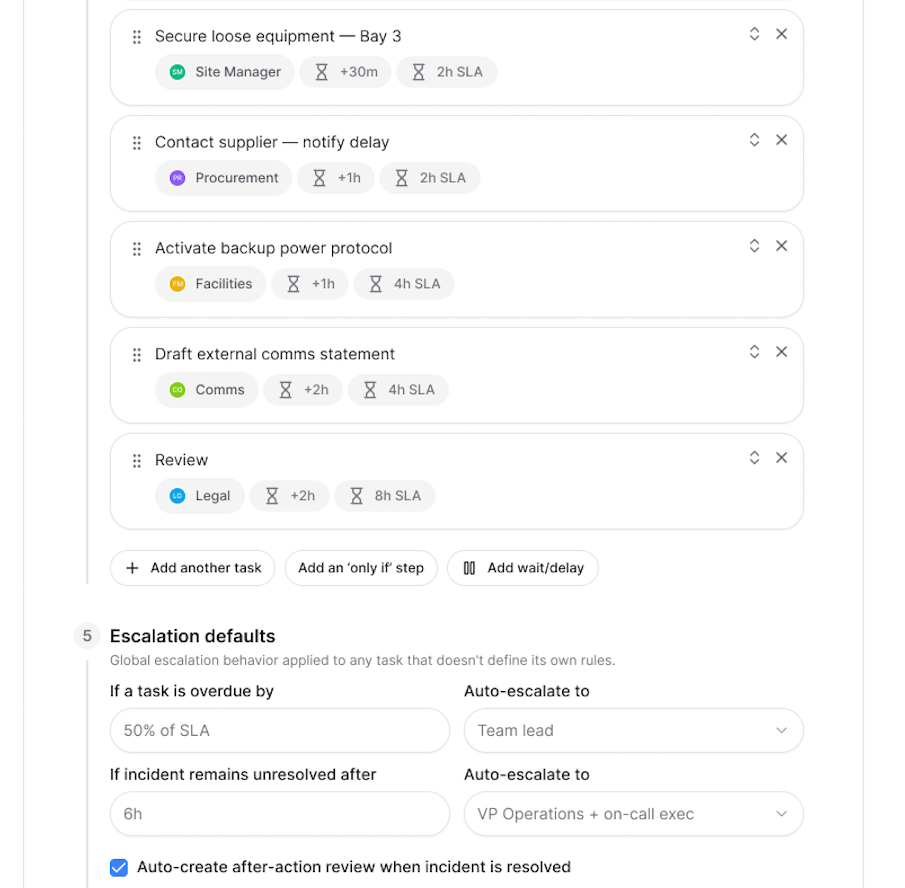
Automated workflows execute complex multi-step protocols: Hurricane response involves dozens of coordinated actions: evacuating people, securing equipment, notifying customers and suppliers, activating business continuity arrangements, protecting critical data, documenting conditions. Modern platforms automate these workflows, ensuring nothing falls through the cracks. When a facility is flagged for evacuation, the system automatically notifies personnel, tracks shelter-in-place locations, confirms all employees are accounted for, and documents the completion of protective measures.
Comprehensive documentation accelerates recovery and claims: Every action — every alert sent, every protocol executed, every employee check-in — is automatically timestamped and documented. This creates a complete record of your hurricane response that serves multiple critical purposes: evidence for insurance claims, documentation of OSHA compliance, data for post-event analysis and continuous improvement, and proof that you took reasonable precautions to protect employees and assets.
Insurance companies are far more responsive when you can show exactly what you did, when you did it, and what conditions existed at each step. This documentation has helped businesses recover faster and receive higher claim settlements.
The critical difference: pre-event decision-making
One of the most significant advantages of modern hurricane preparedness technology is the ability to make better decisions before conditions become critical.
Consider these scenarios:
Scenario 1: The hurricane forecast changes
With manual monitoring: A business leader sees news that a hurricane forecast has shifted 100 miles to the east. They think, "Good, we might avoid it," but they're uncertain. Should they proceed with planned protective measures or cancel them? They call their insurance broker, who says they can't advise on weather decisions. They check the National Weather Service website, which still shows the broader warning polygon. Uncertain, they decide to continue with planned measures, but this indecision costs them in lost productivity and unnecessary precautions.
With modern technology: The system automatically updates with the latest forecast, immediately recalculates which facilities are in the impact cone, and sends updated alerts. Facilities that were in the forecast are now out of it, so protocols are automatically adjusted. Facilities that are now more vulnerable get escalated protocols.
Scenario 2: Supply chain disruption planning
With manual monitoring: A business relies on a key supplier in Miami. As a hurricane approaches, they wonder: Are they in the impact zone? Will they be able to deliver? They try calling the supplier but can't reach them. They don't know whether to arrange alternate sourcing or not. By the time they make alternative arrangements, costs have increased and delivery is delayed.
With modern technology: The system has already flagged that the supplier's facility is in the hurricane forecast cone. Automated alerts notify supply chain managers to activate backup suppliers. Alternative sourcing is arranged before the hurricane arrives, ensuring minimal disruption to your business.
Scenario 3: Workforce availability planning
With manual monitoring: A business doesn't know how many employees will be unable to work after a hurricane. Evacuation zones are announced but the business doesn't systematically track which employees live in those zones. When employees stop showing up to work, the business scrambles to figure out how to operate understaffed.
With modern technology: The system knows where employees live and work. When evacuation zones are announced, it automatically identifies affected employees and notifies management. Business continuity plans that account for workforce disruption are activated before the disruption occurs.
Overcoming the transition: from manual to automated
Shifting from manual monitoring to automated hurricane preparedness represents organizational change that requires attention:
Start with high-impact use cases. Rather than trying to automate everything at once, identify your highest-risk situations: facilities in storm surge zones, critical equipment vulnerable to flooding, supply chain partners in hurricane-prone areas — and implement automated monitoring for these first. Success with high-impact scenarios builds organizational buy-in for broader implementation.
Integrate with existing systems. Modern platforms can integrate with your existing communication systems, business continuity plans, and operational databases. You don't need to replace everything; the new technology enhances and automates existing processes.
Establish clear decision criteria in advance. Don't wait for a hurricane to decide what weather conditions warrant facility closure or activation of business continuity plans. Define these criteria before the season begins, build them into your automated system, and practice them through drills. When an actual hurricane arrives, decisions are made automatically based on pre-established criteria, eliminating dangerous delays.
Train your team on the technology — and on trusting it. If you've been making subjective decisions based on manual monitoring, shifting to automated, data-driven decision-making requires trust and training. Help managers understand how the system makes decisions, show them historical examples of how the system would have performed during past hurricanes, and conduct tabletop exercises so they understand how to use the data to make better decisions faster.
The future-ready business
The storms of this decade will be more powerful and potentially more destructive than those of the last decade. The businesses that will survive and thrive are those that have moved beyond manual monitoring and reactive response.
With modern critical event management technology, hurricane preparedness transforms from a compliance burden into a competitive advantage. The organization that can close only the facilities truly at risk while keeping others operating gains a significant competitive advantage over rivals who close everything conservatively. The business that knows its supply chain vulnerabilities in advance and activates backups before disruption occurs maintains customer relationships that competitors lose. The company that protects critical assets through automated protocols and recovers faster than competitors regains market position while rivals are still assessing damage.
- https://milkeninstitute.org/content-hub/insights/improving-small-business-disaster-response-and-recovery
- https://www.richmondfed.org/region_communities/regional_data_analysis/regional_matters/2026/how_small_businesses_faring_in_aftermath_hurricane_helene https://www.bpr.org/growth-development/2026-04-30/report-details-progress-challenges-for-wnc-businesses-post-helene
- https://www.lakesideps.com/insights/weathering-the-storm-a-hurricane-survival-guide-for-businesses